Ten adaptable exercises help students test assumptions, weigh evidence, examine perspectives and reconstruct arguments across subject areas.
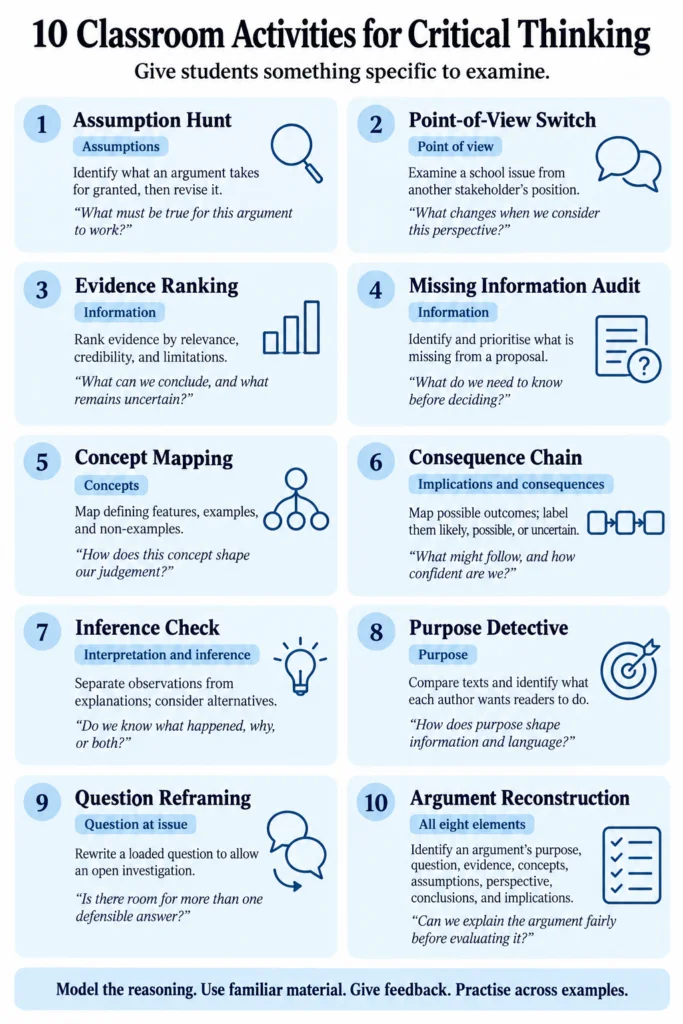
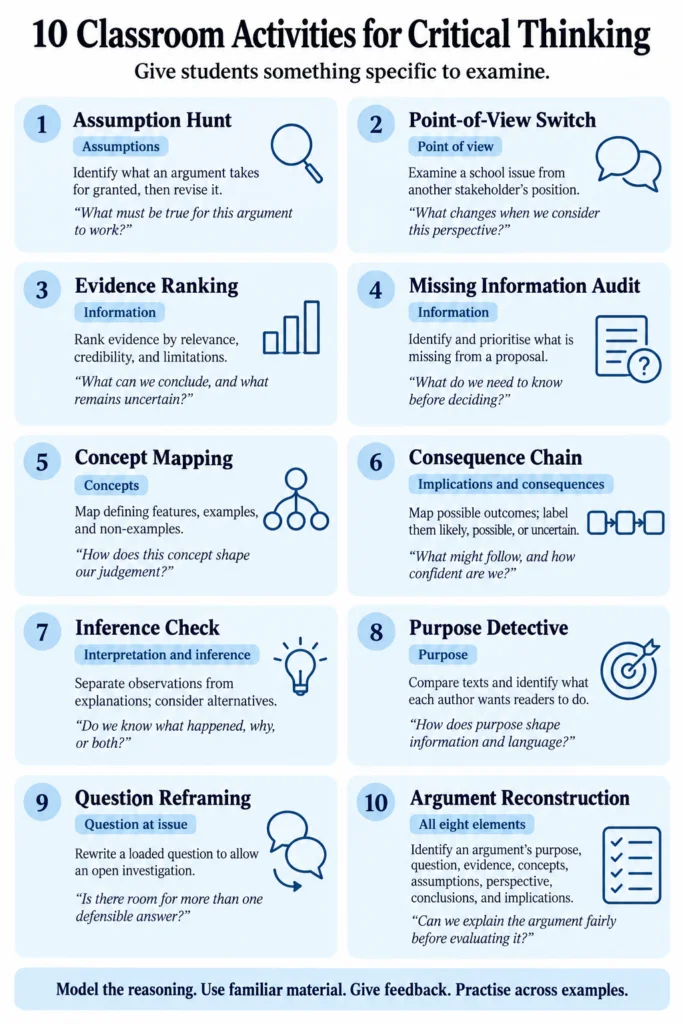
Critical thinking is easier to teach when students can point to the work they’re doing: testing an assumption, weighing evidence or tracing how a conclusion follows from observations. These ten exercises give teachers concrete ways to practise those moves within familiar subject matter.
Together, they cover eight elements of reasoning: purpose, question at issue, information, interpretation and inference, concepts, assumptions, implications and consequences, and point of view. The value lies in making the thinking visible, then asking students to explain and revise it.
Start by examining claims and evidence
1. Find the hidden assumption
Focus: Assumptions
Offer students a short argument with an unstated premise: “All homework should be completed online because students can access it whenever they need it.” Ask what the writer is treating as true. Do all students have reliable internet? Does being able to access an assignment mean a student can complete it independently?
Have students revise the argument to account for one assumption that needs checking.
Ask: What must be true for this argument to work?
2. Rank the evidence
Focus: Information
Pair a claim with several pieces of relevant evidence, such as a personal account, a survey with limited methodological detail and a study students can inspect. Ask students to rank how well each item supports the specific claim.
Require them to explain their rankings in terms of relevance, credibility and limitations. The aim is to connect the strength of a conclusion to the quality of the evidence behind it.
Ask: What can this evidence support, and what remains uncertain?
3. Audit what’s missing
Focus: Information
Give students an incomplete proposal: “Our school should begin classes later because students will learn more.” Before taking a position, have them list what they would need to know. Questions might cover students’ current sleep patterns, transport arrangements and research linking start times to learning.
Ask students to rank the missing information by how much it could change their decision.
Ask: What do we need to know before accepting or rejecting this proposal?
4. Separate observation from explanation
Focus: Interpretation and inference
Start with a clear observation: “Library visits increased after the school introduced a reading competition.” Students should distinguish that reported change from explanations for it. They can propose alternatives and identify what evidence would help test each one.
Close with a written conclusion whose certainty matches the information available.
Ask: Have we established what happened, why it happened, or both?
Examine the lens behind a judgement
5. Map a key concept
Focus: Concepts
Select an idea central to the lesson, such as fairness, adaptation or democracy. Students map its defining features, examples, counterexamples and connections to other ideas.
Comparing maps can surface disagreements worth examining. For instance, students discussing fairness might consider whether treating everyone identically is always fair.
Ask: How does our definition of this concept affect our judgement?
6. Switch points of view
Focus: Point of view
Present a school decision, such as converting part of the playground into a parking area. Students explain their own position, then consider how someone else connected to the issue might see it.
Have them name that person’s priorities, concerns and relevant knowledge. Provide background information so students can build a plausible perspective rather than lean on stereotypes.
Ask: What matters more when you examine the issue from this position?
7. Trace the consequences
Focus: Implications and consequences
Ask students to consider a proposal to remove single-use plastic bottles from school. They map possible near-term and longer-term effects, including who may benefit, who could face difficulties and what conditions might shape the result.
Students label each consequence likely, possible or uncertain, and give a reason for the label.
Ask: What might follow from this decision, and how confident are we?
Related: Critical Thinking in The Age of AI
Clarify the question and the argument
8. Identify the author’s purpose
Focus: Purpose
Give students several texts about the same subject but with different aims: an advertisement, an information sheet and an opinion piece. Ask what each author wants readers to understand, believe or do, and have students support their reading with details from the text.
Ask: How does the author’s purpose shape the information and language they use?
9. Reframe the question
Focus: Question at issue
Begin with a broad or loaded question such as “Why are school uniforms unfair?” Students identify what the wording presumes, then rewrite it to leave room for investigation. One option: “Under what circumstances might a uniform policy create difficulties for students?”
Compare the evidence each version would require.
Ask: Does the question allow more than one defensible answer?
10. Reconstruct an argument
Focus: All eight elements
Give students a short editorial, speech or proposal. Have them map its reasoning by identifying:
- The author’s purpose and the central question
- The information and concepts used
- The assumptions and point of view
- The conclusions drawn
- The consequences of accepting those conclusions
Students should mark which elements the author states directly and which they infer. Then they can identify one part that needs clarification or stronger support.
Ask: Can we explain the argument fairly before evaluating it?
These exercises work best with material students know well enough to investigate. Teachers can model the reasoning, give feedback and revisit the same elements in new contexts. Learning the terminology starts the work; applying it to make and justify judgements is what builds the skill.
The post 10 Classroom Activities for Teaching the Eight Elements of Critical Thinking appeared first on Educators Technology.


Discussion
Sign in to join the discussion.