Most candidates back IPS leaving Enroll Indy, while the forum exposed sharp differences over charter schools, closures, AI and school funding.
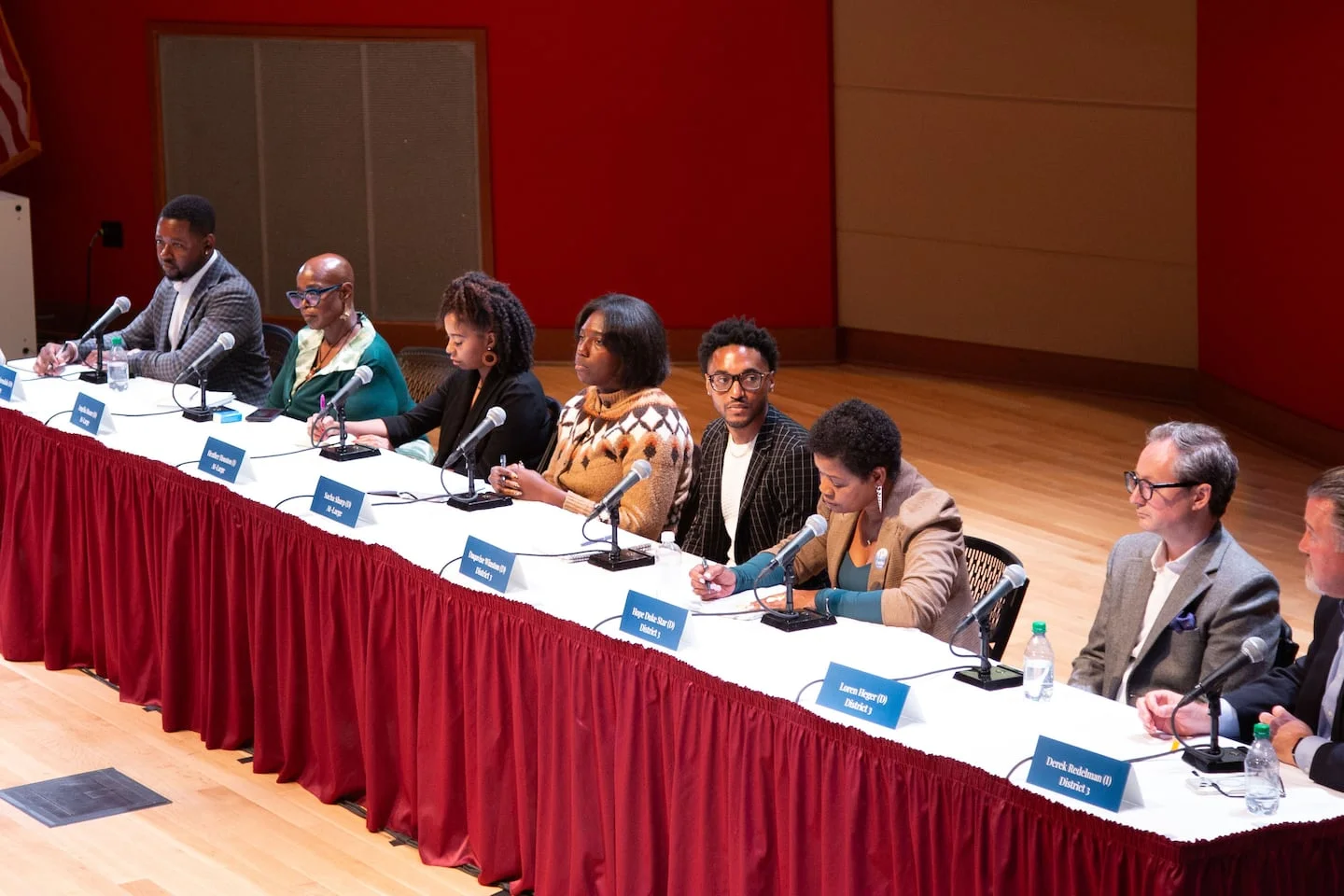
The clearest signal from the Oct. 19 Indianapolis Public Schools board forum was broad support for the district taking control of student enrollment. But candidates’ answers also revealed how difficult it may be to build agreement on the forces shaping the city’s schools: charter and district relationships, possible school closures, artificial intelligence and funding.
Fourteen of the 15 candidates running for five board seats attended the forum at Central Library, hosted by WFYI and Chalkbeat Indiana. District 4 candidate Chris Bultman was absent because of a prior engagement. Voters will choose representatives for Districts 2, 3, 4 and 5, along with an at-large member, on Nov. 3; early voting is underway.
Most candidates back IPS control of enrollment
In September, Superintendent Aleesia Johnson’s administration decided IPS would leave Enroll Indy, the shared enrollment system used by district and charter schools for nine years. The decision has drawn support from people who want IPS to manage enrollment itself and criticism from charter school advocates. The issue has also been part of a broader debate over the district’s departure from Enroll Indy.
When asked to give a one-word answer on the change, 10 candidates said they supported it. At-large incumbent Angelia Moore and District 3 candidate Derek Redelman opposed it. District 5 candidate Yuri Smith Sr. offered qualified support, while District 3 candidate Loren Heger said he was ambivalent and argued that IPS could find a less expensive way to manage enrollment.
IPS has said Enroll Indy costs more than $300,000 a year. Heger said he used the Claude AI chatbot to build a program for district and charter enrollment in minutes. He described the exercise as an example of how the district could seek lower-cost tools instead of treating every dispute as a fight between charter schools and unions.
“That’s the type of thing that we need to do as a district to try to find solutions that don’t cost hundreds of thousands of dollars for software service — that can be done on a phone in 15 minutes,” Heger said. “When we see everything as proxy battles between charters and unions, we don’t see those solutions.”
Charter and district tensions remain a defining fault line
Candidates offered different ideas for reducing the long-running tension between charter and district school supporters. Several answers suggested that the disagreement is about more than where a child enrolls: candidates also differed over who shapes education policy and whose interests board members represent.
District 4 write-in candidate Lindsey Cornett said families should be free to choose charter schools, and she doesn’t fault teachers for working in them. Her concern, she said, is whether Indianapolis can sustain its school system. She blamed some of the hostility on online disputes and said she would not bring that conduct to the board.
Smith said families may not know how traditional IPS schools, Innovation Network schools and charter schools differ. He called for bringing the community into discussions about the city’s schools.
District 2 candidate Bryan Duarte, who is supported by groups backing traditional IPS schools, argued that the system’s divisions are built into its structure. He questioned campaign donations to board members from groups including Stand for Children Indiana and Rise Indy, both of which have supported changes to IPS. Duarte asked whether members elected with large contributions from those groups could represent IPS families’ interests.
His opponent, incumbent Hasaan Rashid, said the board should focus on children’s education across school types. “Doesn’t matter what the school is,” Rashid said. “We’ve got to get off that discussion.”
At-large candidate Alexander Nyirendah and Heger argued that the larger funding divide is between public and private education. Indiana’s private school voucher program cost $548 million last school year. This year, families can use a voucher toward religious or private school tuition regardless of income. Nyirendah said public school supporters were “fighting for peanuts amongst ourselves” while wealthier families received vouchers.
For more on the candidates, read Chalkbeat’s guide to the 2026 IPS school board election.
Closure decisions will involve buildings, services and neighborhoods
A new nine-member, mayor-appointed body, the Indianapolis Public Education Corporation, is expected to take control of buildings and transportation for IPS and charter schools in 2028. Created by state law earlier this year, it must also develop a rating system for district and charter schools. Those ratings could help inform decisions about closures.
At the forum, candidates emphasized different measures they would want considered. Rashid said students at a school that closes should still have access to the same services at their next school. Duarte said the district should look for alternatives before closing schools.
District 5 incumbent Nicole Carey said decisions should start with what a neighborhood needs. She compared school planning with nursing homes, which cannot simply be opened without considering whether a community needs one.
District 3 candidate Daqavise Winston focused on the students and families who would be affected. The district, he said, needs to understand who attends a school under consideration and identify the next closest location for those families.
Moore and District 5 incumbent Hope Duke Star pointed to building conditions and use. Star said an empty building matters when the district weighs its finances, even if community members would prefer not to discuss that factor. The answers point to a difficult balancing act: candidates will have to weigh neighborhood needs and continuity of services alongside the cost and use of school buildings.
AI prompts competing priorities
Candidate views on AI in schools were divided. Smith said the district has more immediate concerns, including making sure students can read. Carey argued that IPS needs clear policies because students and schools cannot ignore a technology that is changing quickly.
Heger took a more categorical position, saying AI should not be encouraged in education, even if students are already using it. Redelman said schools should teach students to understand the technology and use it responsibly while continuing to learn core subject matter. The exchange showed how candidates differ not just on whether AI belongs in classrooms, but on whether schools should treat it as a tool to govern or a distraction from more urgent needs.
Watch a video of the Oct. 19 IPS school board candidate forum.
Most seek more state support, especially for special education
Most candidates said Indiana lawmakers should provide more funding for schools, with special education a particular concern. IPS estimates that the cost of special education services exceeds the state and federal funding it receives by $24 million.
Redelman, who has worked with lawmakers on education legislation, said district leaders should change how they make their case. Repeatedly asking for more money, he argued, is unlikely to be persuasive. He said legislators may be more receptive to a discussion about how schools can improve their use of existing funds.
Independent candidates question party labels
This election is Indiana’s first to feature partisan school board candidates. Twelve candidates are running as Democrats. Cornett’s write-in campaign has no party affiliation, while at-large candidate Heather Houston and Redelman are running as independents.
Houston has voted in Democratic primaries, and Redelman has voted in Republican primaries, according to voting records. Both said they chose independent candidacies because they don’t believe school board races should be partisan. Their position adds another dimension to a contest where candidates are already debating how political groups, school types and public funding shape IPS decisions.
Voters will decide the five seats on Tuesday, Nov. 3. The board’s next members will inherit immediate questions about enrollment and funding, as well as a longer-term role in decisions about school buildings and closures.


Discussion
Sign in to join the discussion.