Students in the U.S. and India can use hundreds of free textbooks in Gemini Notebook, with cited answers and tools for creating study materials.
A textbook catalog changes the job of an AI study tool
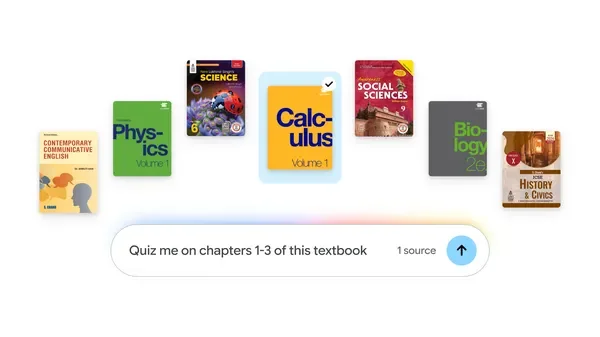
Gemini Notebook is adding hundreds of free textbooks for students in the U.S. and India, turning its source-based answers and study tools into a more course-focused resource. The catalog includes titles from OpenStax, Open Textbook Library and S Chand Publishing. That gives students a way to work with assigned or relevant course material inside the same product they use to ask questions and organize research. The shift matters because general-purpose AI assistants can produce fluent explanations without making clear which source supports each claim. A notebook organized around a chosen textbook offers a more bounded starting point: the student selects the material, and the system is meant to ground its answers in that source.
Free access is a practical feature, but the catalog’s value will depend on whether its books match what students actually need. A large collection can still leave gaps across subjects, course levels, languages and local curricula. The announcement identifies participating publishers and availability in two countries; it doesn't establish that every course or institution will find its required text there. For students who do find a match, though, bringing reading and study activities together could reduce the friction of switching between a book, notes and separate quiz tools.
Why source-based answers matter
Answers draw directly on the selected textbook and include inline citations with links to the original source. Citations can make an AI answer easier to check: a student can follow the link, compare the response with the passage, and see whether the explanation reflects the assigned material. That’s a meaningful distinction from an answer that arrives without a visible connection to a source. It doesn't make the answer automatically correct, however. A system can misread a passage, omit a qualification or cite a relevant section that doesn't fully support its wording. Students still need to check the underlying text, especially when a response compresses a complicated explanation into a few sentences.
This is more significant than it looks. In education, the question isn't only whether an answer sounds plausible; it's whether a learner can trace how it relates to the material they're expected to understand. Citations may help students practice that habit, provided the links are clear and the cited passages are relevant. They may also help a teacher or parent review how a student reached an explanation. The feature is a support for verification, not a substitute for it.
That distinction matters because textbook material is structured. A chapter may introduce terms in a particular order, build from earlier concepts and use examples that carry meaning within the course. A general answer can miss that sequence. Grounding a response in a selected book may keep it closer to the course’s vocabulary and framing, though the source selection still shapes what the tool can explain. If the relevant information isn't in the selected material, students may need to consult another source or ask a narrower question.
From reading to practice
Students can also turn textbook material into study guides, practice quizzes and flashcards. These formats serve different purposes: a study guide can help organize key ideas, a quiz can prompt recall, and flashcards can support repeated review. Combining them with textbook access could make it easier to move from reading to practice without manually rebuilding the material in another app. But generated study aids need scrutiny. A quiz can reward memorizing a simplified version of a topic, and a flashcard can strip away context that matters. Useful tools still depend on the quality of the prompts and the student's willingness to return to the source when something seems off.
Here's the thing: convenience can help students begin studying, but it can also make a weak summary feel complete. A study guide that looks tidy isn't proof that it covers the chapter's central reasoning. Students should treat these outputs as drafts to work with, checking them against the textbook and adding anything their course emphasizes. The tool can help with practice; it can't know, from the announcement alone, which details a particular instructor will expect a student to explain.
And this is the part most people overlook: study features don't just deliver information, they influence how students spend their attention. A quick quiz may encourage active recall, while a summary may encourage scanning. Both can be useful, but they ask the learner to do different work. Students who rely only on short generated formats may miss the longer explanations and connections that make a chapter coherent.
Finding the books
To browse the catalog, open a notebook, choose “Add sources” and select “Textbooks.” This flow makes the source choice explicit, which is useful: the student can see that the notebook is tied to a selected book rather than assuming that every response reflects an entire course. The selection also gives the tool a defined body of material to draw from. What this means for you depends on whether the available titles fit your class and whether you prefer studying in a notebook interface.
The catalog draws on OpenStax, Open Textbook Library and S Chand Publishing. Their inclusion gives the collection a mix of textbook sources, but the announcement doesn't specify the subjects, editions or individual titles available. Those details will determine how useful the catalog is in practice. A student looking for a particular edition should check the listing rather than assume that a familiar title is present or that its content matches an instructor’s assigned version.
The wider significance—and the limits
The update extends Google’s Expert Intelligence initiative, introduced last month, which connects people with trusted sources across Google AI products. In this case, textbooks are the source category, and the study tools are built around them. The broader product idea is straightforward: AI responses become more useful when people can choose relevant material and inspect where an answer comes from. Yet the word “trusted” doesn't remove the need to examine how the material is selected, how answers are generated, or how well citations support each response.
For students, the strongest case is practical rather than grand. A free textbook paired with tools for questions and revision may make course material easier to access and revisit. For Google, textbooks give a more defined setting for AI assistance than open-ended questions do. The test will be whether students can find books that fit their studies, whether the citations help them verify explanations, and whether generated practice materials support real understanding.
If you're working in this space, the useful measure won't be the size of the catalog by itself. It’ll be whether students can move between an answer and its source without losing the thread of the lesson. A textbook can anchor the interaction, but the quality of the learning still depends on how the student uses it. More accessible study material. That’s a promising direction, with the ordinary but important caveat that a polished interface can't do the reading for anyone.


Discussion
Sign in to join the discussion.